- Contact: +91 9958374323
- Email: info@analytx4t.com

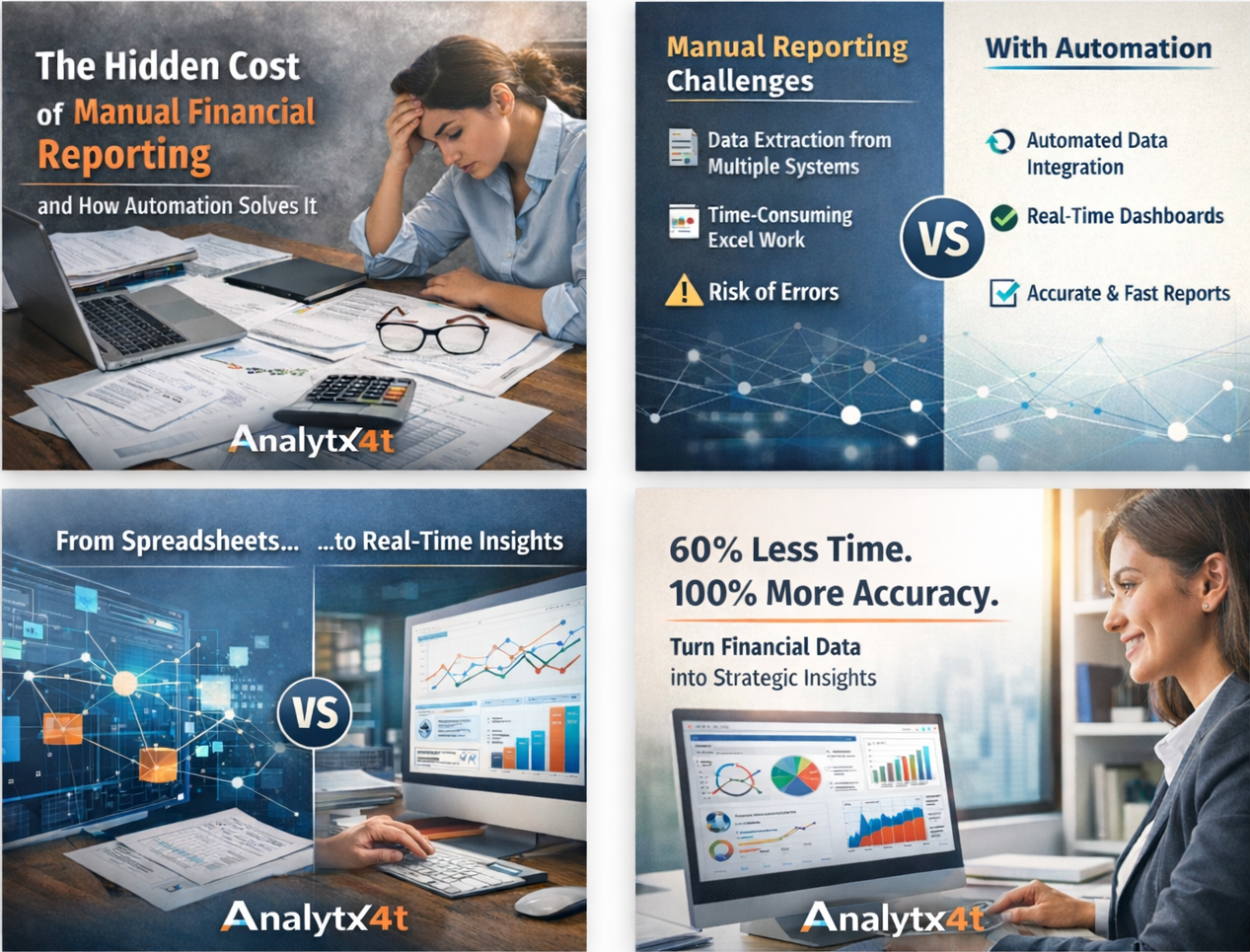
Financial reporting is one of the most critical responsibilities for any organization. Yet, many finance teams still rely heavily on manual processes to create multiple reports for different stakeholders. What appears to be routine work often turns into a time-consuming, error-prone cycle that slows down decision-making.
At Analytx4t, we regularly work with finance teams facing this exact challenge.
Finance teams are often required to generate multiple types of reports, including:
Although the underlying data is largely the same, it is pulled from multiple systems, cleaned manually, reformatted repeatedly, and then shared in different versions.
This approach leads to:
A single finance team may need to extract data from accounting software, CRM systems, and spreadsheets—then reconcile and rework that data for each report.
When business leaders ask for updated numbers, the data is often already outdated, making it difficult to respond quickly and accurately.
Automation eliminates repetitive effort by creating a centralized and intelligent reporting system. This includes:
This allows finance professionals to focus on analysis, forecasting, and strategy rather than manual report creation.
Organizations that implement automated financial reporting typically experience:
Automation turns finance from a reporting function into a strategic business partner.
Manual reporting not only drains productivity but also limits business agility. Organizations that embrace financial automation gain clarity, speed, and confidence in their decisions.
Analytx4t helps finance teams move from manual reporting to intelligent, automated financial insights.
Recent Comments