- Contact: +91 9958374323
- Email: info@analytx4t.com
As organisations move from experimenting with AI chatbots to deploying autonomous AI agents, a fundamental challenge is becoming increasingly important:
How do we ensure that an AI system remembers the right information, retrieves the right data, maintains continuity and protects sensitive business information?
To understand this, we need to look beyond prompt engineering and understand something called Context Engineering.
Let’s break down some important concepts.
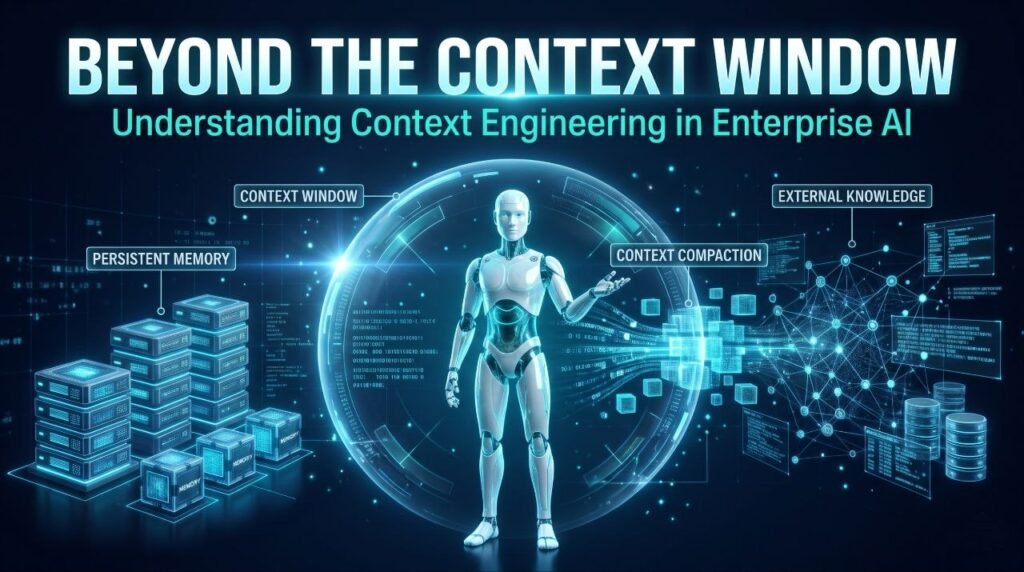
An LLM does not have unlimited capacity to process information at one time.
Its context window represents the amount of information it can consider during a particular interaction.
This can include:
A larger context window provides more capacity, but more information does not automatically mean better answers.
The real challenge is supplying relevant information rather than overwhelming the model with unnecessary data.
Consider an AI agent working on an audit assignment over several days.
It accumulates conversations, document extracts, observations, tool outputs and decisions.
Eventually, its active context may become too large.
Context compaction helps address this by compressing accumulated information while preserving important details such as:
The objective is not simply to shorten conversation history. It is to preserve the information required to continue the work.
A common misconception is that an AI agent should remember everything inside its conversation history.
That is not a scalable enterprise architecture.
Business information should live in appropriate external systems:
The agent retrieves relevant information when required.
This is where Retrieval-Augmented Generation (RAG), databases and persistent state management work together.
These concepts are often confused.
A thread represents a continuing conversation.
A session represents a period of interaction.
A context window is the information available to the model at a particular time.
Persistent memory retains selected information that may be useful across interactions.
For enterprise applications, conversation history alone should never be treated as the source of truth for business operations.
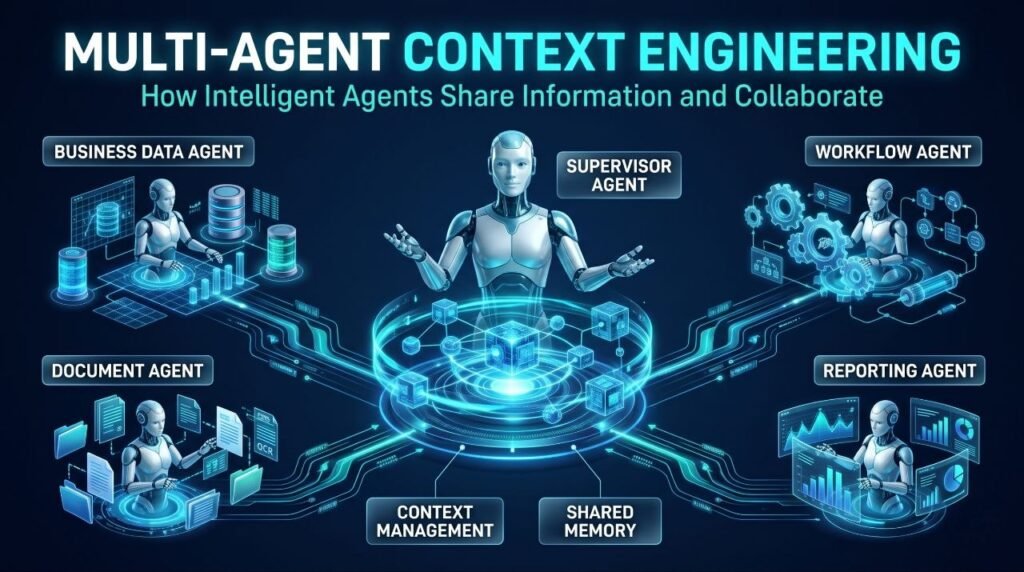
Imagine an AI-powered ERP with specialist agents for:
A common mistake is passing the entire conversation and every agent’s intermediate output to every other agent.
A better architecture gives each agent only the information required for its responsibility.
The supervisor maintains shared execution state, while specialist agents exchange structured and relevant outputs.
This reduces unnecessary context consumption and improves maintainability.
This is where the discussion becomes particularly important for enterprise AI.
Imagine a CA firm managing 50 clients.
An employee has permission to access ABC Ltd but not XYZ Ltd.
The employee asks an AI assistant to compare their GST reconciliation.
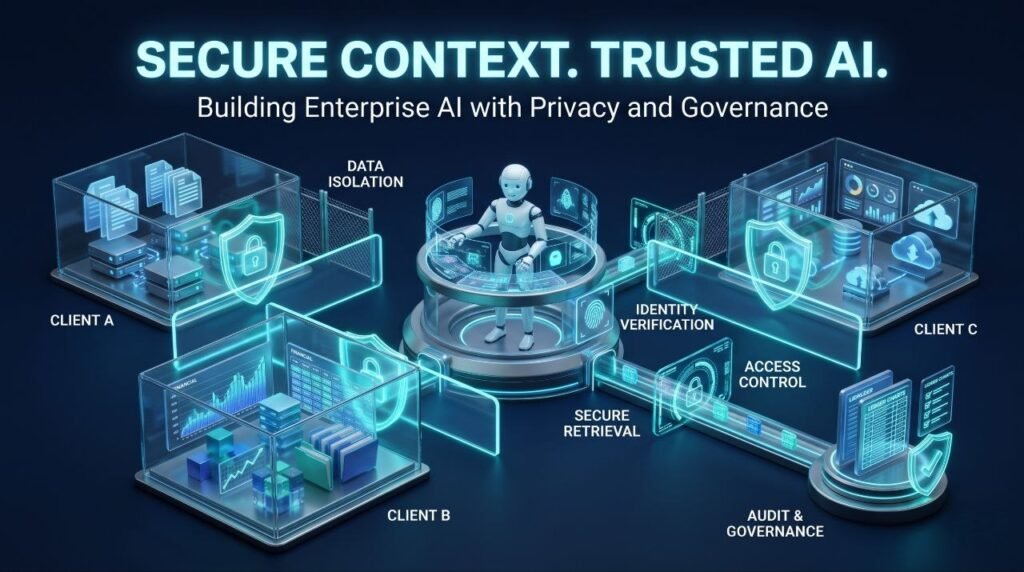
The AI system must not retrieve XYZ Ltd’s confidential information simply because it exists in the organisation’s database or persistent memory.
Security must be enforced before information enters the model’s context.
A robust architecture should include:
Never rely on an LLM prompt as the primary mechanism for enforcing data confidentiality.
Security must be implemented at the application, retrieval and data layers.
At a high level, a production-ready AI application needs several interconnected capabilities:
These are not isolated features. They form the foundation of reliable agentic systems.
As we work on AI-powered business automation across ERP, audit, legal and healthcare workflows, one architectural principle is becoming increasingly clear:
The future of enterprise AI will not be determined by the LLM alone, but by how intelligently we manage the information, memory, state and permissions surrounding it.
An AI system that can generate an impressive answer is useful.
An AI system that can maintain continuity across complex workflows, retrieve verified information, respect business permissions and produce consistent outcomes is much closer to being production-ready.
The transition from AI assistants to dependable AI agents requires us to think beyond prompts and models.
It requires us to engineer the entire context around intelligence.
Recent Comments