- Contact: +91 9958374323
- Email: info@analytx4t.com
The conversation around Artificial Intelligence is rapidly shifting from chatbots and copilots to autonomous AI agents.
Businesses are increasingly exploring systems that can interact with databases, access documents, execute workflows, coordinate with other agents and automate operational activities.
But there is an important question we need to ask:
What makes an AI agent reliable enough to operate in a real business environment?
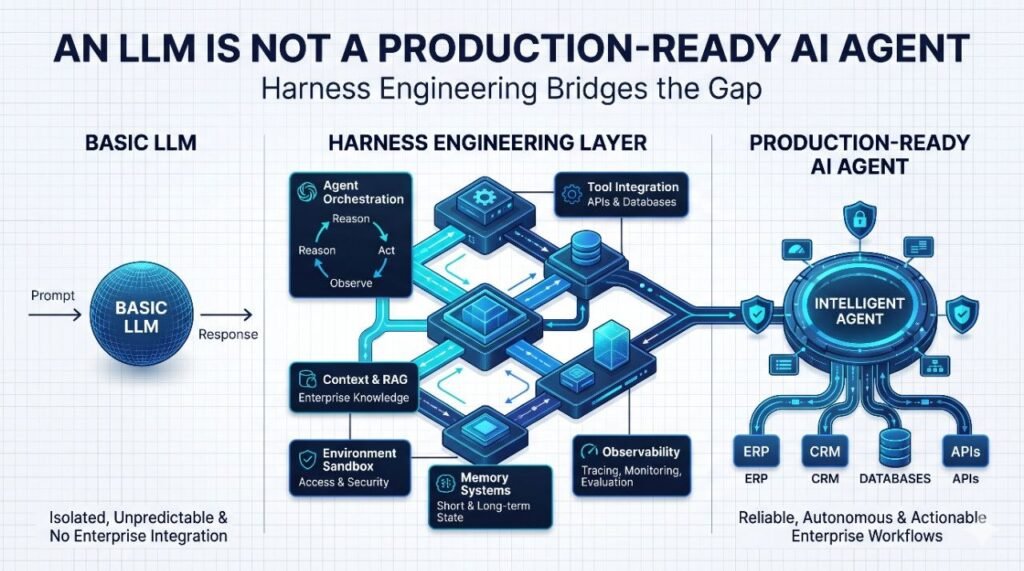
Connecting an LLM to a collection of tools does not automatically create a dependable AI agent.
An LLM can understand instructions, reason about information and generate responses. But to turn those capabilities into consistent business actions, we need an engineered system around it.
This is where Harness Engineering becomes important.
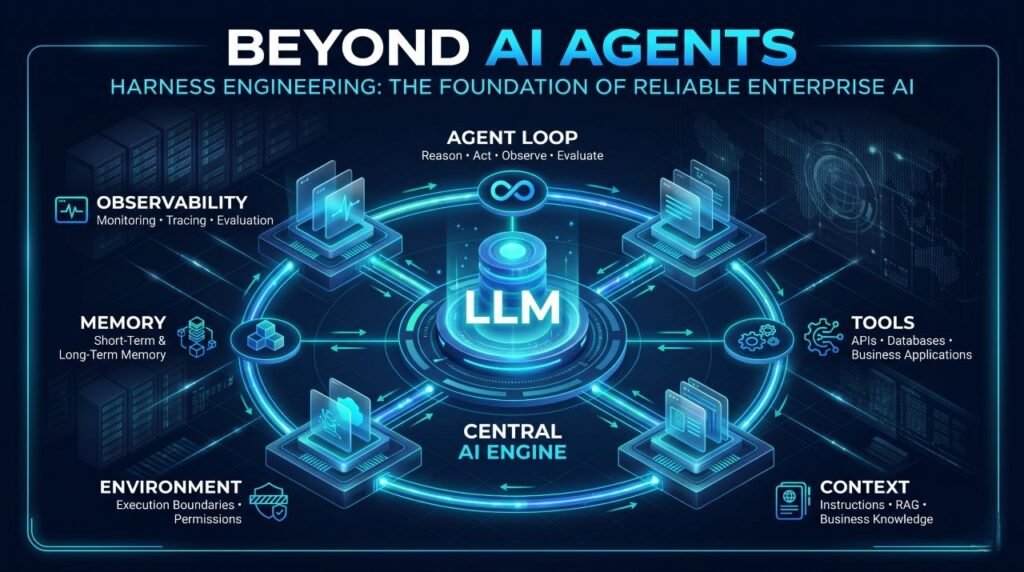
An agent harness is the engineered system surrounding a language model that enables it to interact with external systems, execute actions, maintain continuity and produce measurable outcomes.
Think of the LLM as the intelligence engine.
The harness provides the infrastructure, tools, controls and feedback mechanisms that allow this intelligence to operate within a defined environment.
A useful way to understand an agent harness is through six interconnected components.
An AI model typically generates a response based on the information it receives.
An agent needs something more: the ability to repeatedly reason, act, observe the outcome and decide what to do next.
A typical agent execution loop looks like this:
For example, consider an AI agent assigned to prepare a daily operational report.
It may retrieve attendance records, examine timesheets, identify incomplete assignments, analyse exceptions and prepare a management report.
The agent does not simply generate an answer. It progresses through a sequence of actions until the defined task is completed.
However, reliable execution also requires stopping conditions, error handling, retry limits and human approval where necessary.
An LLM cannot independently access an organisation’s ERP, CRM or database.
Tools provide that capability.
Examples include:
An important engineering principle is to design tools that are small, specific and predictable.
For example, instead of providing an AI agent with unrestricted database access, we can expose specific functions:
This provides better control over what an agent can access and execute.
It also creates an important distinction between deterministic business operations and AI reasoning.
For instance, financial calculations should generally be performed using validated Python or SQL logic. The LLM can then interpret the results, explain exceptions and recommend appropriate actions.
The objective is not to make AI responsible for everything. It is to give AI the right capabilities with clearly defined boundaries.
An AI model cannot make reliable decisions without relevant information.
Context can include:
The challenge is not simply providing more information. It is assembling the right information for each interaction.
Consider an AI agent working on a financial reconciliation.
It needs the relevant transaction records, applicable business rules, previous observations and calculation results.
It does not need every document or transaction in the organisation.
This is where Context Engineering, RAG, retrieval strategies and context management become important.
In our previous discussion on Context Engineering, we explored how AI systems manage information and memory.
Harness Engineering takes that discussion further by connecting context management with the complete execution architecture of an AI agent.
This is an important component of enterprise AI architecture.
Tools allow an agent to perform actions. The environment defines where those actions execute and what boundaries apply.
For example, an AI coding agent may operate inside a sandbox rather than having unrestricted access to a developer’s computer.
Similarly, an enterprise AI agent should operate within controlled business environments.
Consider a CA firm managing multiple clients.
An agent working on one client’s GST reconciliation should have access only to the authorised records and tools required for that assignment.
The environment and application architecture should enforce:
An intelligent agent should not automatically have unrestricted authority simply because it can execute actions.
An AI agent should not have to rediscover everything every time it performs a task.
Memory enables relevant information to persist across interactions.
We can broadly distinguish between two categories.
Short-term memory:
Long-term memory:
However, memory is not the same as storing everything in a conversation history.
Enterprise applications need appropriate storage and retrieval mechanisms for business records, documents, historical decisions and task execution state.
The agent should retrieve relevant information when needed rather than continuously loading everything into its context window.
This may be one of the most important requirements when moving AI from experimentation into production.
Imagine an AI agent generates an incorrect financial report.
Looking only at its final response will not tell us where the problem originated.
Did it retrieve incorrect information?
Did a database function return unexpected results?
Did the LLM misunderstand the tool output?
Did the agent execute the wrong sequence of actions?
Without observability, identifying the root cause becomes difficult.
A production AI system should provide visibility into:
This enables engineering teams to monitor, debug, evaluate and continuously improve their AI systems.
For businesses, it also creates greater transparency and accountability.
Consider an AI-powered ERP designed for a professional services organisation.
A business owner wants to understand the organisation’s daily operational performance.
An agent-based system could work as follows:
The Loop: Determines the steps required to prepare the report.
Tools: Retrieves attendance, timesheet, assignment and financial information through approved ERP functions.
Context: Receives relevant business rules, employee information and verified calculation results.
Environment: Operates within defined permissions and access boundaries.
Memory: Maintains relevant task history and previously identified unresolved issues.
Observability: Records execution steps, tool calls, errors and performance metrics.
The result is not merely an AI-generated summary.
It is a controlled workflow that transforms operational data into actionable business intelligence.
As organisations begin deploying AI agents, we need to move beyond the mindset of simply connecting an LLM to a chatbot interface.
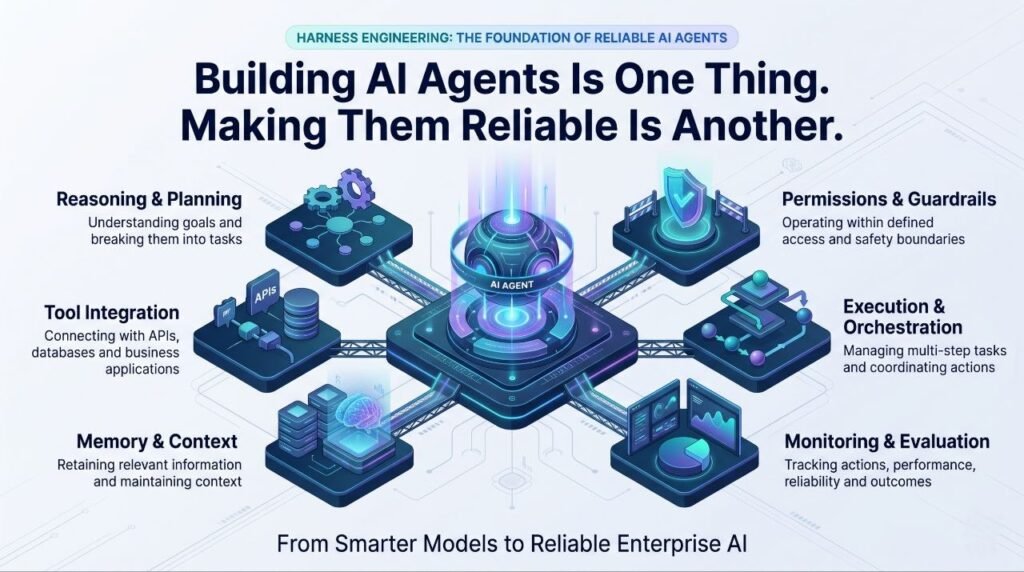
A production-ready AI system requires several engineering capabilities working together:
These capabilities collectively help bridge the gap between an impressive AI demonstration and a dependable production application.
As we work on AI-powered business automation across ERP, audit, legal and healthcare workflows, we believe the next phase of enterprise AI will be defined by how effectively organisations engineer the systems surrounding their AI models.
The real opportunity is not simply to build agents that can answer questions.
It is to build agents that can understand business context, interact with enterprise systems, execute defined activities, respect operational boundaries and produce measurable outcomes.
An AI agent that can reason is useful.
An AI agent that can reason, act, verify, maintain continuity and operate within controlled business environments is much closer to becoming a dependable part of an organisation’s workforce.
The future of enterprise AI is not just about better models. It is about better-engineered systems around those models.
The direction we believe enterprise AI development needs to move towards.
Recent Comments