- Contact: +91 9958374323
- Email: info@analytx4t.com
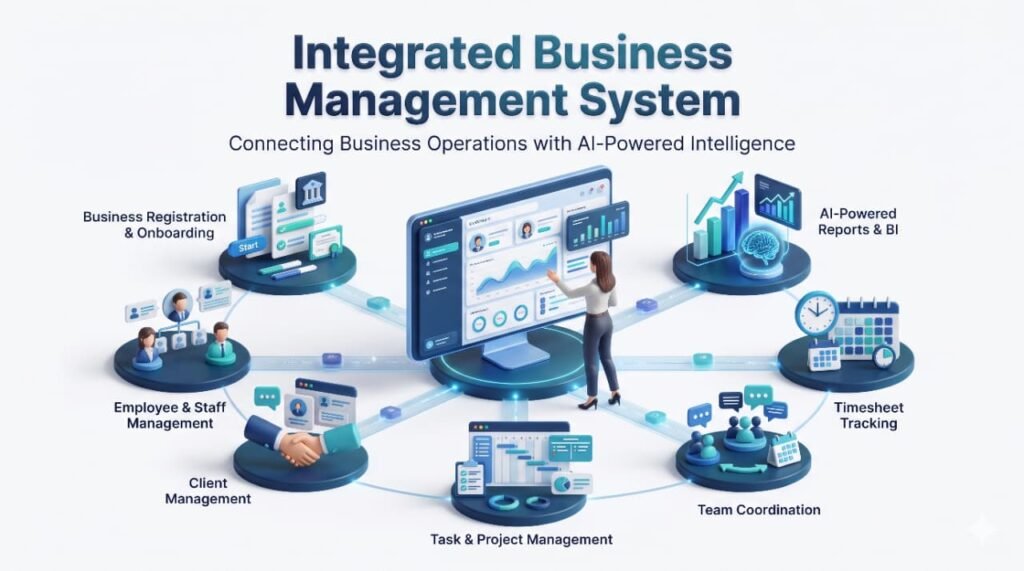
Managing day-to-day business operations becomes increasingly complex as organizations grow. Employee information, client records, task assignments, team activities, working hours, project progress, and management reports are often maintained across multiple spreadsheets, disconnected applications, and communication channels.
This creates operational challenges for business owners, administrators, and team managers. Getting a consolidated view of organizational activities becomes difficult, tracking employee productivity requires manual effort, and management often lacks timely insights into workload distribution, resource utilization, and overall business performance.
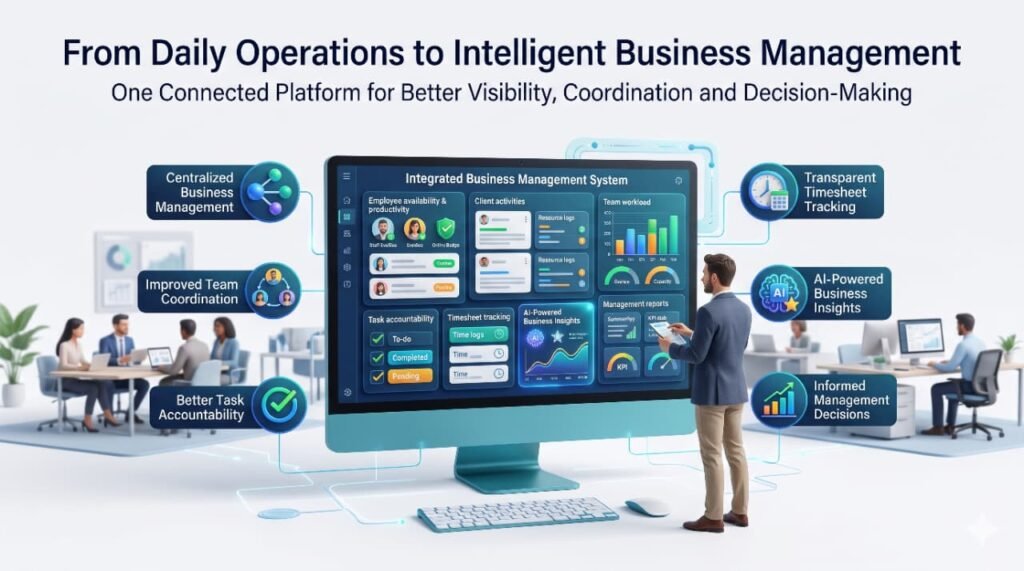
To address these challenges, we developed the Integrated Business Management System (IBMS) – an integrated platform designed to centralize an organization’s operational activities within a single system.
The platform connects business registration, staff onboarding, client management, team management, task allocation, task review, timesheet tracking, and administrative reporting.
Beyond traditional business management capabilities, IBMS incorporates AI-powered reporting and business intelligence. It enables management to generate operational summaries, understand employee and team performance, review client-wise efforts, and retrieve business information through natural-language queries.
The result is a centralized operational ecosystem that helps organizations manage their daily activities, improve visibility across teams, streamline resource allocation, and make more informed business decisions using AI-driven insights.
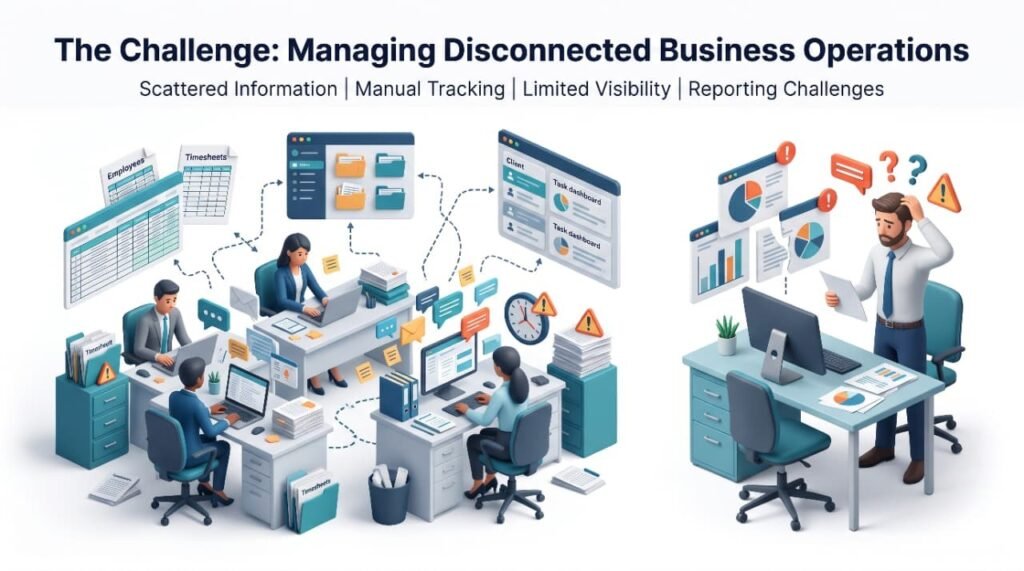
Organizations often use different tools to manage employees, clients, daily tasks, working hours, and operational reporting.
While these tools may solve individual problems, managing them independently creates gaps in coordination, visibility, and accountability.
Business owners and managers need to access information from multiple sources to understand what is happening across the organization.
1. Disconnected Business Information
Business details, employee records, client information, task assignments, and timesheets are often maintained separately. This makes it difficult to establish a unified view of business operations.
2. Manual Staff and Client Management
Employee and client onboarding involves collecting and maintaining information through separate forms, spreadsheets, or manual records. Managing these records becomes increasingly difficult as the organization expands.
3. Limited Task Visibility
Managers need to know which employees are working on which tasks, what activities are pending, and which assignments have been completed. Without centralized task tracking, monitoring progress and accountability becomes challenging.
4. Complex Team Coordination
Distributing work across teams requires visibility into employee responsibilities, availability, workload, and existing assignments. Lack of centralized information can make resource allocation less efficient.
5. Inconsistent Timesheet Tracking
Tracking employee working hours and the time spent on different tasks or clients is essential for understanding productivity and resource utilization. Manual tracking can make this process difficult to monitor and analyze.
6. Limited Management-Level Insights
Management often spends considerable time collecting information from different operational sources before preparing reports or reviewing organizational performance.
7. Lack of Accessible Business Intelligence
Traditional dashboards may display information, but managers still need to navigate multiple sections, interpret data, and prepare summaries to answer everyday business questions.
The objective was to create a unified platform where organizations could manage their complete operational lifecycle, from business registration and employee onboarding to task execution, timesheet tracking, and management reporting.
The platform also needed an AI-powered intelligence layer that could convert operational data into understandable insights and allow management to interact with business information using natural language.
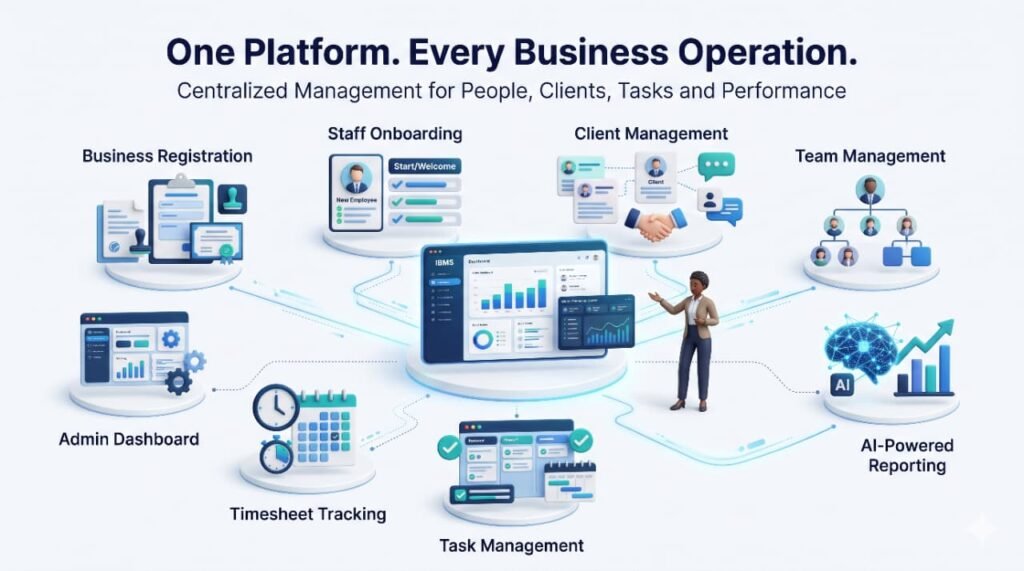
We developed IBMS as a centralized platform that connects essential office management and business operations into one unified ecosystem.
Instead of managing different operational activities through separate applications, organizations can use a structured system to maintain records, assign responsibilities, track work, review performance, and access management insights.
The platform is built around interconnected operational modules.
These capabilities work together to provide a connected view of organizational activities rather than isolated records across different departments.
The platform begins with a structured business registration process.
Organizations can register through dedicated forms and maintain their essential business information within the system.
Key capabilities include:
This creates the foundation for managing staff, clients, teams, and operational activities within the platform.
The Staff Management module provides administrators with a centralized interface to register employees and maintain their professional information.
Employees can be onboarded through dedicated registration forms, creating structured records that can be used across the platform.
Key capabilities include:
This provides management with better visibility into employee information, responsibilities, availability, and utilization.
IBMS also provides a dedicated Client Management module for registering and managing organizational clients.
Each client can have a centralized profile containing relevant business information and associated operational activities.
Key capabilities include:
By connecting clients with employees, teams, tasks, and timesheets, the platform provides a structured view of client-related operations.
Task management is one of the central components of IBMS.
The module enables managers and administrators to create tasks, assign responsibilities, monitor progress, and maintain visibility into ongoing work.
Key capabilities include:
Managers can use the system to understand who is working on which task, what work is pending, and how effectively responsibilities are distributed.
This improves operational transparency and creates a structured approach to task ownership and accountability.
Managing individual tasks is only one part of organizational operations. Managers also need to understand how work is distributed across teams and whether assignments are progressing as expected.
IBMS provides a structured workflow for team management and task review.
Key capabilities include:
This creates a connected management workflow between employees, team leads, and administrators.
It also helps managers review work more systematically rather than depending entirely on informal communication.
Timesheet Management provides a structured way to record employee working hours and understand how time is distributed across different tasks and clients.
The module helps organizations maintain records of employee efforts and analyze resource utilization.
Key capabilities include:
Timesheet information also contributes to management reporting by connecting recorded working hours with employees, tasks, and client activities.
This helps organizations gain better visibility into how their resources are being utilized.
One of the most important differentiators of IBMS is its AI-powered reporting and business intelligence layer.
Traditional management systems primarily provide dashboards and predefined reports. While these are useful, management often needs to navigate multiple sections, identify relevant information, and manually interpret the data to answer specific business questions.
IBMS extends this capability by introducing AI-assisted reporting and natural-language interaction.
The platform uses available operational information from employee records, client profiles, tasks, timesheets, and business activities to generate meaningful management insights.
The system can generate AI-powered summaries that help management understand organizational activities without manually reviewing every operational record.
These summaries can cover:
The objective is to transform operational records into understandable information that management can review more efficiently.
IBMS incorporates automated management summaries to provide visibility into business activities at different points during the day.
Morning Summary
Helps management understand the operational position at the beginning of the day, including pending tasks, ongoing assignments, employee availability, and relevant workload information.
Evening Summary
Provides an overview of the day’s activities, including completed tasks, pending work, employee efforts, and important operational observations.
These summaries help management stay informed without having to manually collect information from multiple modules.
The platform also enables management to retrieve business information using natural-language questions.
Instead of manually navigating multiple dashboards or preparing database queries, authorized users can ask questions in simple language and receive responses based on available organizational data.
Example queries include:
This makes organizational information more accessible to business owners, administrators, and managers.
By bringing together information from multiple operational modules, the AI reporting layer helps management understand relationships between employees, teams, clients, tasks, and working hours.
For example, management can use the available data to review:
The goal is to help management move beyond simply viewing operational data toward understanding what that data means for the organization.
The Admin Dashboard provides administrators and management with a consolidated view of organizational operations.
Rather than accessing multiple independent systems, management can review important operational information through a centralized interface.
Key capabilities include:
The dashboard acts as a central management layer, helping administrators monitor activities across different operational modules.
IBMS supports operational reporting and performance analysis using the information maintained across different modules.
It helps organizations understand:
These insights help management identify bottlenecks, improve resource planning, and evaluate organizational performance.
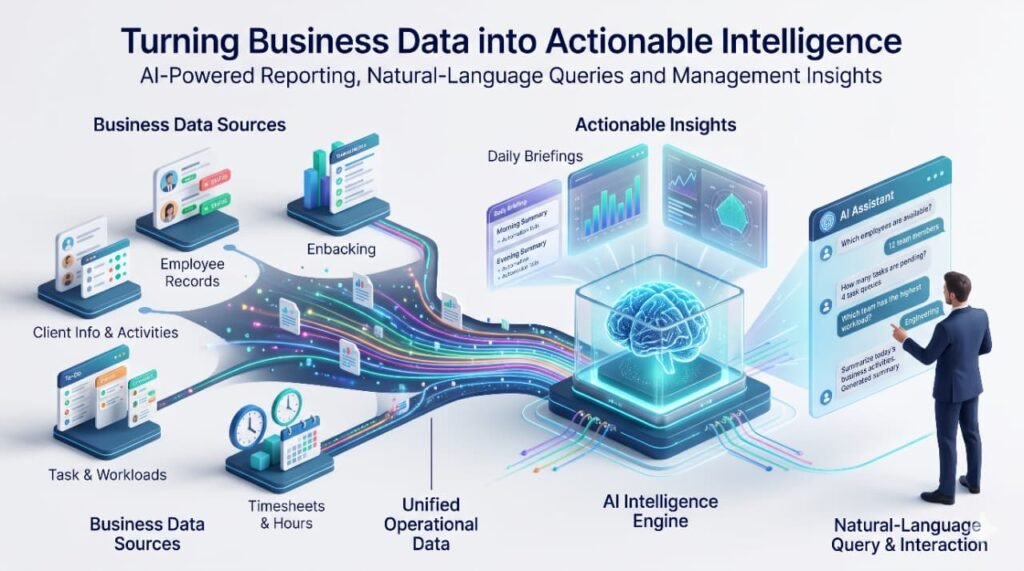
IBMS follows a connected operational workflow in which each module contributes to the overall management of the organization.
The process begins with organizational registration and continues through employee onboarding, client management, task execution, timesheet tracking, and AI-powered reporting.
The organization registers through a dedicated form and establishes its business profile within the platform.
Administrators register employees, maintain their profiles, and organize employee information for operational management.
Clients are registered through dedicated forms, creating centralized client profiles that can be associated with projects, tasks, and business activities.
Employees are organized into teams, and their availability and responsibilities can be considered during work allocation.
Managers create tasks and assign them to relevant employees or teams against specific client activities.
Employees work on their assigned activities while managers monitor task progress, review completed work, and track pending assignments.
Working hours and time spent on specific tasks and client activities are recorded, creating a structured record of employee effort.
Operational data from different modules is used to generate management summaries, productivity insights, and natural-language business query responses.
Management accesses a consolidated operational view to understand workload, task progress, employee utilization, client-wise efforts, and overall business activities.
This end-to-end structure connects the organization’s daily activities within one centralized platform.
IBMS brings together operational functions that are often managed independently, providing organizations with a more structured and transparent way to manage everyday business activities.
1. Centralized Business Operations
Business information, staff records, client details, tasks, timesheets, and reporting are managed within a unified platform.
2. Structured Employee Management
Dedicated onboarding and employee management capabilities help organizations maintain centralized staff records and manage responsibilities.
3. Improved Client Management
Client information is connected with relevant employees, teams, tasks, and operational activities, providing better visibility into client-related work.
4. Better Task Allocation and Accountability
Task creation, assignment, and progress tracking help establish clear ownership and improve visibility into ongoing work.
5. Improved Team Coordination
Team management and task review capabilities provide managers with a structured way to monitor assignments, review completed work, and understand team workloads.
6. Transparent Timesheet and Effort Tracking
Timesheet records help organizations understand employee working hours and time spent across different tasks and clients.
7. AI-Powered Management Reporting
AI-generated summaries reduce the effort required to collect and interpret operational information for management reviews.
8. Natural-Language Access to Business Information
Management can ask questions in simple language and retrieve relevant information from available organizational data.
9. Better Resource Planning
Employee availability, workload, task assignments, and timesheet information provide a more complete view of resource utilization.
10. More Informed Management Decisions
A consolidated operational dashboard and AI-assisted insights help management understand business activities and identify areas that may require attention.
IBMS demonstrates how a traditional office management system can evolve into an integrated business operations and intelligence platform.
The foundation of the platform is a centralized operational data structure connecting businesses, employees, clients, teams, tasks, and timesheets.
On top of this foundation, workflow-based modules manage the organization’s day-to-day activities, while dashboards provide operational visibility.
The AI layer extends the platform by transforming available operational data into summaries, reports, and natural-language responses.
The overall approach combines three important capabilities:
Operational Management
Structured modules for onboarding, employee management, client management, task allocation, team coordination, and timesheet tracking.
Centralized Data and Reporting
Connected operational records and administrative dashboards that provide visibility across the organization.
AI-Powered Business Intelligence
AI-generated summaries and natural-language queries that help management retrieve, understand, and analyze organizational information.
This architecture positions IBMS as more than a conventional employee or task management application. It connects operational execution with management-level intelligence.
The broader vision behind IBMS is to make business operations easier to manage, monitor, and understand through a centralized intelligent platform.
Organizations should not have to depend on multiple disconnected applications or manually prepare reports to understand their everyday activities.
A connected business management ecosystem can help business owners and managers maintain visibility into:
With AI-powered reporting and natural-language interaction, this information becomes more accessible and easier to interpret.
The long-term direction is to move from a system that simply records business activities toward one that helps management understand operational performance and make better-informed decisions.
The Integrated Business Management System (IBMS) represents a shift from disconnected office management processes toward a centralized, AI-powered business operations ecosystem.
By connecting business registration, staff onboarding, client management, team management, task allocation, task review, timesheet tracking, administrative dashboards, and AI-powered reporting, the platform provides organizations with a unified approach to managing their daily operations.
Its AI capabilities further extend traditional business management functionality by generating operational summaries, supporting productivity analysis, and allowing management to retrieve business information through natural-language queries.
The larger value is not just having all operational modules in one place. It is connecting the information generated across those modules and making it useful for everyday management decisions.
The Integrated Business Management System (IBMS) brings business operations, workforce management, client activities, and AI-powered business intelligence together in one centralized platform.
Recent Comments