- Contact: +91 9958374323
- Email: info@analytx4t.com

Financial operations often involve repetitive, data-intensive processes that require significant manual effort, particularly when organizations need to generate thousands of invoices and debit notes.
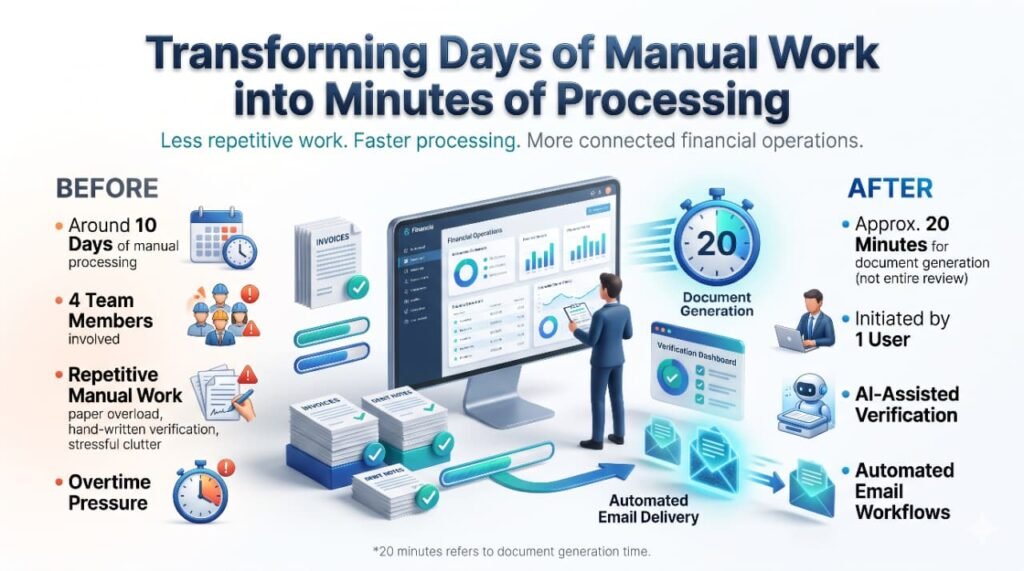
A client faced this challenge while processing approximately 10,000 invoices and debit notes. The existing process required eight team members to handle data processing, document generation, verification, and related operational activities. Depending on the workload, completing the process could take several days, with team members sometimes working overtime to meet deadlines.
To address this challenge, we developed an automated financial document generation solution that combines structured data processing, predefined financial business rules, workflow automation, and AI-powered agents.
The solution allows users to upload structured data and initiate the document generation process. The system applies the configured financial logic, generates the required invoices and debit notes, and uses an AI agent to assist with document verification. Another AI agent supports email communication and document delivery through the configured workflow.
With the automated solution, approximately 10,000 invoices and debit notes can be generated in around 20 minutes, significantly reducing document generation time and manual effort.
The result is a streamlined financial operations workflow that helps the client process high volumes of documents more efficiently while maintaining appropriate verification and human oversight.
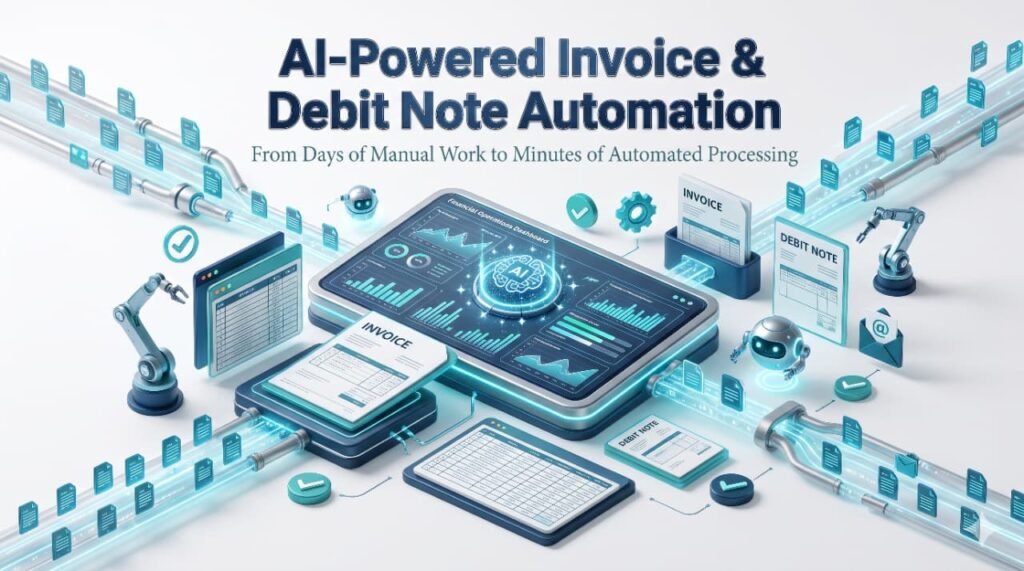
Generating invoices and debit notes at scale can become a major operational challenge when the process relies heavily on manual activities.
Each document must be generated using the appropriate financial information and business rules. The resulting documents must then be reviewed, checked for inconsistencies, and delivered to the relevant recipients.
When thousands of documents need to be processed, these repetitive tasks consume substantial time and resources.
The client’s existing workflow required eight team members to manage the process, creating a significant operational burden.
High-Volume Document Processing
The client needed to generate approximately 10,000 invoices and debit notes, requiring consistent processing of a large volume of structured financial records.
Time-Consuming Operations
The existing process involved multiple manual activities, making document generation a time-intensive task that could take several days to complete.
Heavy Dependence on Manual Effort
Eight team members were involved in handling the process, including data preparation, document generation, verification, and related operational tasks.
Overtime and Deadline Pressure
The team sometimes needed to work overtime to complete document processing within the required timelines, increasing workload and operational pressure.
Document Accuracy and Consistency
Invoices and debit notes must follow predefined financial rules and contain the correct information. Manually processing large datasets increases the effort required to maintain consistency and identify potential errors.
Repetitive Verification and Communication
After generation, the documents needed to be checked and shared with the relevant clients. Email preparation, document distribution, and responses introduced additional repetitive work.
The client needed a solution that could process thousands of financial documents quickly, apply consistent business rules, reduce manual intervention, and streamline verification and communication.
The objective was not simply to generate documents faster, but to redesign the entire workflow into a more efficient and scalable process.
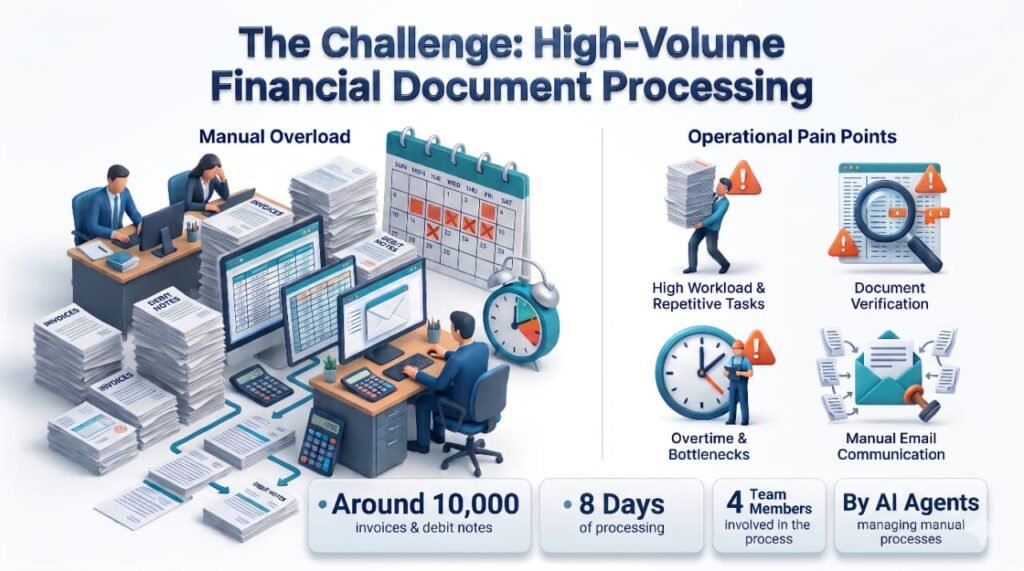
We developed a centralized invoice and debit note generation solution designed to automate repetitive financial operations and integrate AI agents into the verification and communication stages.
The system uses structured data as its input and applies predefined financial logic to generate the required documents.
Once the documents are generated, AI-powered verification helps identify potential inconsistencies. A separate AI agent supports the communication workflow, helping prepare and deliver approved outputs and handle routine email responses within its configured scope.
The solution combines three key capabilities:
This architecture allows predictable financial operations to be handled by deterministic processing, while AI agents support tasks that benefit from contextual interpretation and automated communication.
The complete process follows a structured workflow, beginning with data upload and continuing through document generation, verification, and delivery.
The process begins when the user uploads a structured dataset containing the information required to generate invoices and debit notes.
The input data includes the relevant transaction details, financial fields, and other information required by the configured business rules.
Instead of manually preparing each document, the user provides the necessary data through a centralized workflow.
This simplifies the starting point of the process and reduces repetitive manual effort.
After the data is uploaded, the system processes the records and prepares them for document generation.
The application checks whether the required fields are available and whether the records can be processed according to the configured rules.
Where applicable, incomplete or inconsistent records can be flagged for further review rather than being processed without validation.
This stage helps establish a consistent input structure before financial documents are generated.
Once the data is prepared, the system applies predefined financial business logic to generate the required invoices and debit notes.
The logic determines how the relevant input fields are processed and how the resulting documents are created.
Instead of preparing documents individually, the application processes the records in batches, significantly reducing the time required for repetitive document generation.
The key result: approximately 10,000 invoices and debit notes can be generated in around 20 minutes.
This dramatically improves processing speed compared with the previous manual workflow.
Importantly, financial calculations and document generation follow explicit business rules rather than relying on an AI model to independently determine financial values.
After the documents are generated, an AI verification agent supports the review process.
Its purpose is to examine relevant document information against the available source records and configured validation requirements.
Depending on the checks implemented, the agent can assist in identifying:
The verification agent adds an additional review layer to the automated process, helping the team focus on exceptions rather than relying entirely on manual inspection.
AI-assisted verification does not replace formal financial controls or guarantee that every discrepancy will be detected. Human review remains important for exceptions and sensitive financial decisions.
Once documents have passed the required verification and approval stages, the communication agent supports the delivery workflow.
This agent helps automate repetitive email-related activities associated with sharing the generated invoices and debit notes.
Its responsibilities can include:
This reduces the manual effort required to distribute documents and manage repetitive email interactions.
Recipient validation, access permissions, and approval requirements remain essential, particularly when financial documents are sent externally.
The final stage ensures that documents requiring review are addressed before completion.
After the relevant verification and approval requirements are satisfied, the documents can be delivered to the intended clients through the configured communication workflow.
This creates a connected process in which document generation, verification, and delivery work together instead of operating as separate manual activities.
The result is a more efficient financial workflow with reduced manual involvement and improved operational coordination.
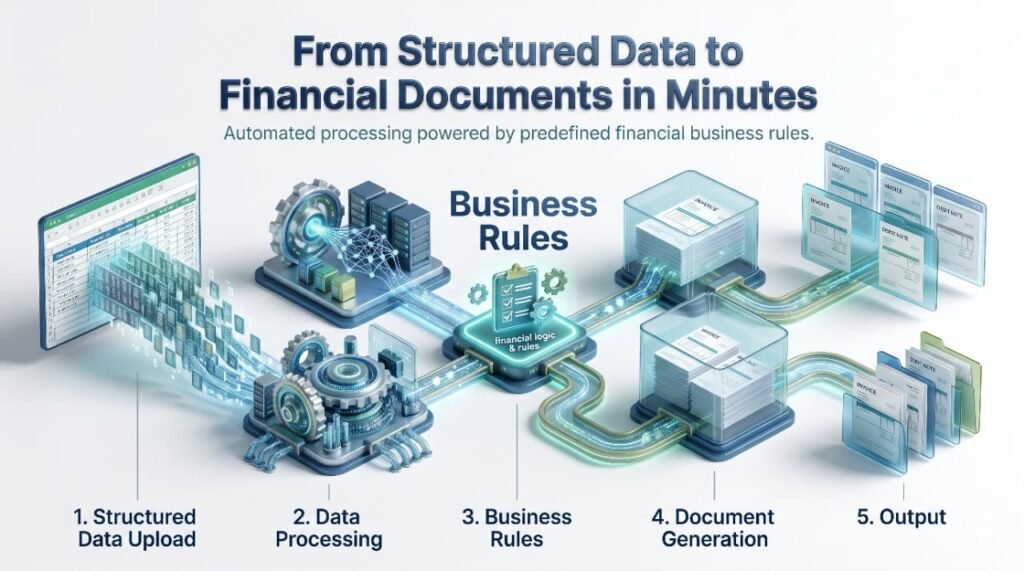
A defining aspect of this implementation is the combination of conventional automation and AI-powered agents.
Rather than using AI for every operation, the system assigns each component a clearly defined responsibility.
The generation engine processes structured records and applies predefined financial rules to create invoices and debit notes.
Its primary responsibility is to execute predictable, repeatable operations consistently and efficiently.
The verification agent assists in reviewing generated documents against available source information and configured validation requirements.
It helps identify potential discrepancies and directs attention toward records that may require additional review.
The communication agent supports email preparation, document distribution, and routine responses through the configured workflow.
It reduces the manual effort associated with repetitive communication tasks.
Human oversight remains part of the workflow for exceptions, approvals, and cases requiring financial judgment.
This ensures that automation improves operational efficiency without removing the necessary accountability from financial processes.
Structured Data → Data Processing → Rule-Based Document Generation → AI-Assisted Verification → Human Review Where Required → Automated Email Delivery
This architecture combines the reliability of deterministic business logic with the flexibility of AI-assisted verification and communication.
The implementation significantly changed how the client handles high-volume invoice and debit note generation.
The previous workflow required substantial manual effort from eight team members and could take several days to complete. The automated solution reduced the document generation stage to approximately 20 minutes.
| Business Metric | Previous Process | Automated Process |
|---|---|---|
| Document volume | Approximately 10,000 invoices and debit notes | Approximately 10,000 invoices and debit notes |
| Document generation time | Several days | Approximately 20 minutes |
| Team involvement | Eight team members | Processing initiated by a single user |
| Processing approach | Manual, repetitive activities | Automated, rule-based processing |
| Document verification | Manual review effort | AI-assisted verification with human oversight |
| Email communication | Repetitive manual activities | Automated email workflow with AI assistance |
| Operational workload | Significant manual effort and occasional overtime | Reduced manual involvement in routine processing |
The approximately 20-minute figure refers to document generation. Total completion time may also include validation, verification, exception handling, approvals, and final delivery.
The solution reduced document generation from a process that previously took several days to approximately 20 minutes.
This allows the client to process large volumes of financial documents much more efficiently.
The process can now be initiated by a single user, with the system handling the repetitive document generation tasks.
This reduces dependence on continuous manual involvement throughout the generation stage.
By automating repetitive activities, the solution helps the team spend less time preparing individual documents and more time on exception handling, review, and other valuable financial operations.
Faster processing helps reduce the operational pressure associated with high-volume workloads and tight completion deadlines.
Predefined business logic ensures that the configured rules are applied systematically across the processed records.
This supports consistency and makes the document generation process easier to manage.
The verification agent adds a review layer that helps identify potential inconsistencies and directs attention toward documents that may require additional checks.
The communication agent reduces repetitive email work by supporting document delivery and routine responses through the configured workflow.
The automated workflow provides a more efficient foundation for processing recurring financial document volumes without requiring the same level of manual effort for generation.
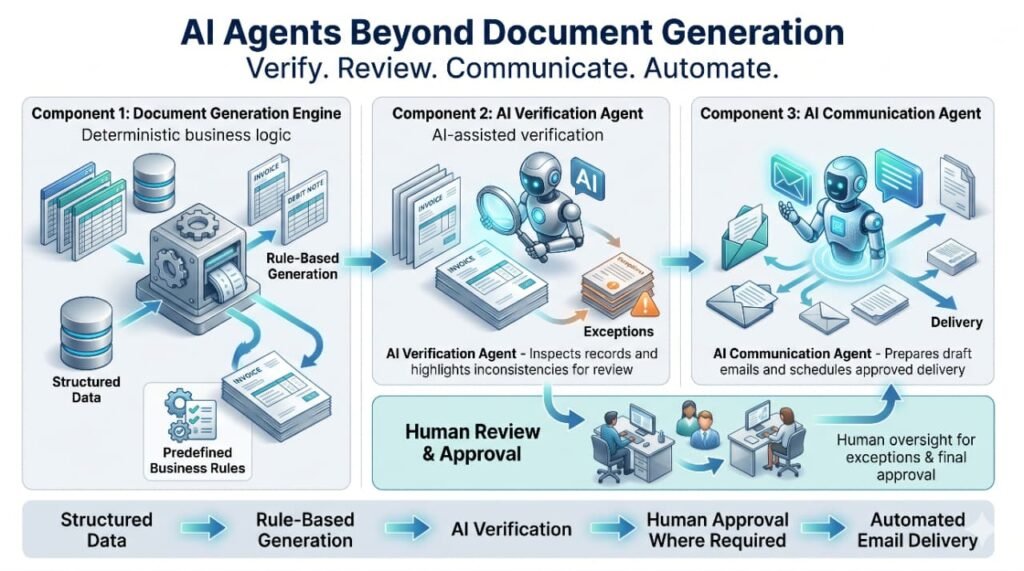
This use case demonstrates how traditional automation and AI agents can work together to improve enterprise financial operations.
Not every stage requires artificial intelligence. Financial document generation often depends on explicit rules, predictable calculations, and consistent data processing.
These operations are better handled by deterministic application logic, where the same inputs and rules should produce consistent outputs.
AI agents add value in supporting verification and communication tasks, where interpreting information, identifying potential inconsistencies, and handling routine email interactions can reduce manual effort.
The solution follows three fundamental principles:
Automate predictable operations. Use structured data processing and predefined financial rules for document generation.
Apply AI where it adds value. Use AI agents to support verification and communication rather than replacing financial logic with unrestricted model-generated outputs.
Maintain human oversight. Keep appropriate review and approval controls for exceptions and sensitive financial actions.
This approach makes AI adoption more practical for financial operations by combining operational speed with defined business controls.
Finance teams frequently manage processes that are repetitive, data-intensive, and governed by established business rules.
Invoice generation, debit note preparation, document verification, and client communication are all areas where workflow automation can reduce operational effort.
However, automating document creation alone does not address the entire challenge.
The broader opportunity comes from connecting the different stages into a coordinated workflow.
By combining structured data processing, rule-based generation, AI-assisted verification, and automated communication, organizations can reduce repetitive work while retaining oversight of important financial decisions.
This approach can also serve as a foundation for extending automation to other document-intensive financial processes, subject to their specific business rules, data requirements, and control mechanisms.
This client success story demonstrates how workflow automation and AI agents can transform a time-consuming financial document generation process.
By automating the creation of approximately 10,000 invoices and debit notes in around 20 minutes, the solution significantly reduced generation time and manual effort compared with the previous process.
The addition of AI-powered verification and communication extended the benefits beyond document creation, connecting the major stages of the workflow into a more efficient operational process.
The broader lesson is that effective enterprise AI is not about applying AI to every task. It is about combining reliable business logic, structured automation, AI-assisted capabilities, and human oversight to solve real business problems.
For organizations managing high volumes of financial documents, this approach offers a practical path toward faster processing, improved operational efficiency, and more scalable financial workflows.
Recent Comments