- Contact: +91 9958374323
- Email: info@analytx4t.com
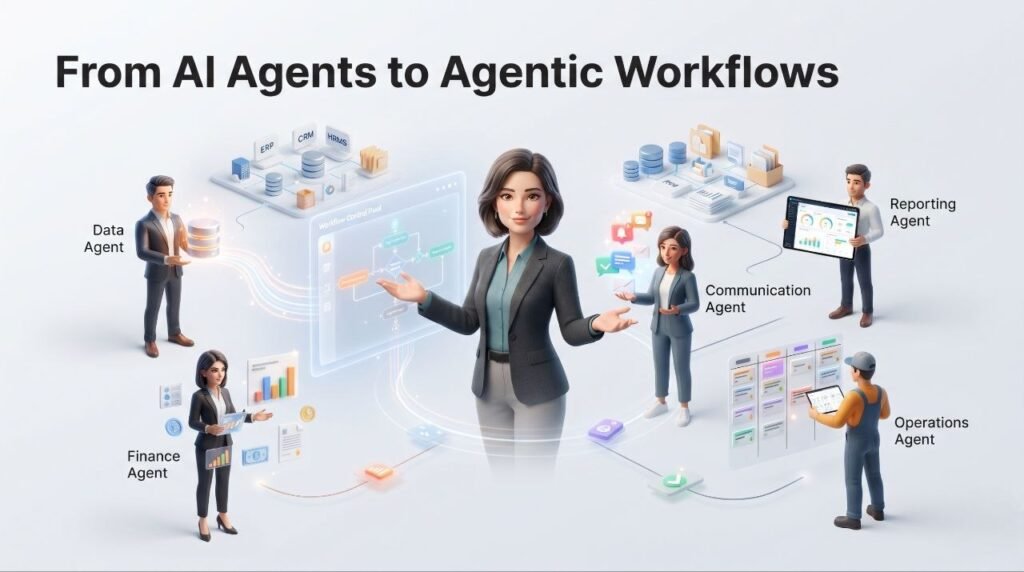
Artificial Intelligence is moving beyond answering questions and assisting employees.
We are entering a phase where AI agents can interact with enterprise applications, retrieve business information, execute defined activities, coordinate with other agents and participate in complete business workflows.
But there is an important distinction we need to understand:
Building an AI agent is not the same as automating a business process.
An individual AI agent may perform a specific task effectively. However, real business operations involve multiple interconnected activities, systems, decisions, dependencies and approvals.
The real opportunity lies in connecting these capabilities into coordinated, intelligent workflows.
This is where Agentic Business Automation becomes important.
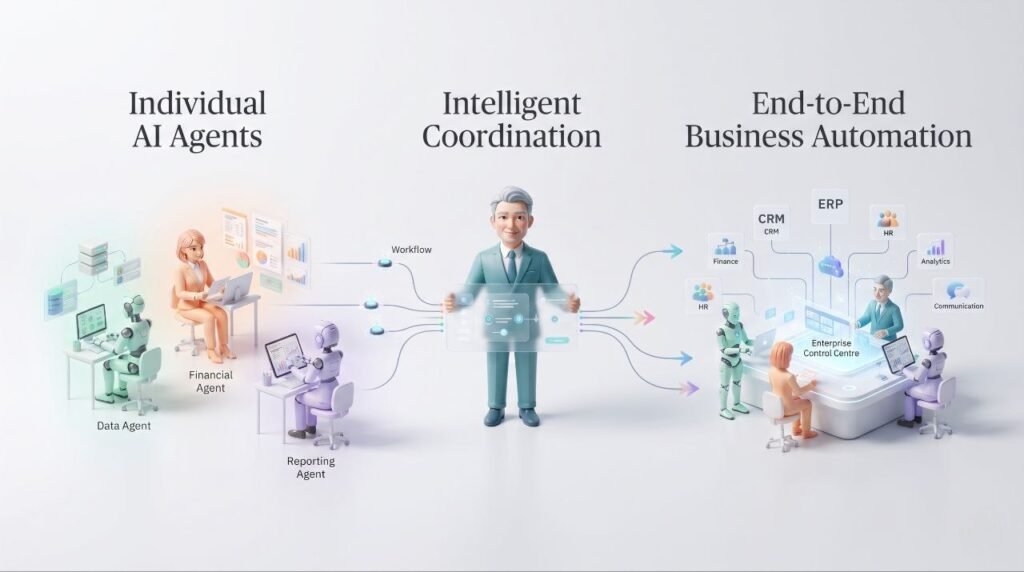
Let’s understand the difference.
A conventional AI assistant responds to a user’s instruction.
An AI agent can go further by using tools, retrieving information and executing defined tasks.
An agentic workflow connects multiple activities and potentially multiple specialist agents to achieve a larger business objective.
Consider a simple example.
A business owner wants to understand why certain client assignments are delayed.
A conventional approach requires employees to:
An agentic workflow could coordinate these activities:
Instead of automating isolated tasks, we are automating a complete business process.
One common misconception is that a single powerful AI agent should handle everything.
In complex business environments, a better approach may be to distribute responsibilities across specialist agents.
For example, an AI-powered ERP could have:
Data Agent
Retrieves information from databases and enterprise applications.
Operations Agent
Monitors assignments, employee activities and operational exceptions.
Finance Agent
Analyses financial records and identifies reconciliation differences.
Reporting Agent
Consolidates verified information into management reports.
Communication Agent
Prepares notifications, reminders and follow-ups.
Supervisor Agent
Coordinates activities, manages dependencies and monitors overall workflow progress.
Each agent has a defined responsibility, approved tools and access permissions.
The supervisor coordinates their work according to the business objective.
However, multiple agents are not always necessary. A well-designed workflow with one agent and several deterministic functions may be more efficient for simpler processes.
The objective is not to maximise the number of agents. It is to design the simplest architecture that reliably completes the business process.
Consider an organisation that wants to automate its daily operational reporting.
A typical agentic workflow could look like this:
Step 1: Trigger
The workflow starts at a predefined time or when a specific business event occurs.
Step 2: Data Retrieval
Approved tools retrieve information from the ERP, CRM or other enterprise applications.
Step 3: Deterministic Processing
Python, SQL or predefined business rules calculate KPIs, validate records and identify exceptions.
Step 4: AI Analysis
An LLM interprets the verified results, identifies patterns and generates explanations.
Step 5: Agent Coordination
Specialist agents perform their assigned activities and exchange structured outputs.
Step 6: Human Review
Sensitive decisions, exceptions and high-impact actions are routed to authorised employees for approval.
Step 7: Execution
Approved actions are executed through controlled APIs and business functions.
Step 8: Monitoring
The system records execution, exceptions, task completion and performance metrics.
This combination of deterministic processing, AI reasoning, orchestration and human oversight is what makes agentic workflows suitable for real business applications.
This is one of the most important architectural decisions when building enterprise AI solutions.
Not every business activity requires an LLM.
Consider financial reconciliation.
Calculating the difference between two financial records is a deterministic operation.
A Python function or SQL query can perform this calculation consistently.
But understanding why the difference occurred may require additional information, contextual interpretation and business reasoning.
A sensible enterprise AI architecture divides responsibilities:
For example, an AI system processing GST reconciliation should not depend on an LLM to calculate financial totals when deterministic code can do it more reliably.
The LLM can help explain discrepancies, classify exceptions and suggest corrective actions.
The goal is not to replace deterministic systems with AI. It is to combine deterministic accuracy with AI reasoning.
Businesses already operate with ERP, CRM, HRMS, accounting software and industry-specific applications.
Replacing these systems simply to introduce AI may not be practical.
Instead, AI agents can interact with existing enterprise applications through controlled integrations.
For example:
This creates an intelligent automation layer around existing enterprise infrastructure.
The business can gradually introduce automation without redesigning every existing application.
The opportunity extends across almost every business function.
Finance and Accounting
Human Resources
Professional Services and Audit
Healthcare
Sales and Customer Operations
The common opportunity is to identify activities involving repetitive information retrieval, predefined rules, multiple systems and recurring human coordination.
These are strong candidates for agentic workflow automation.
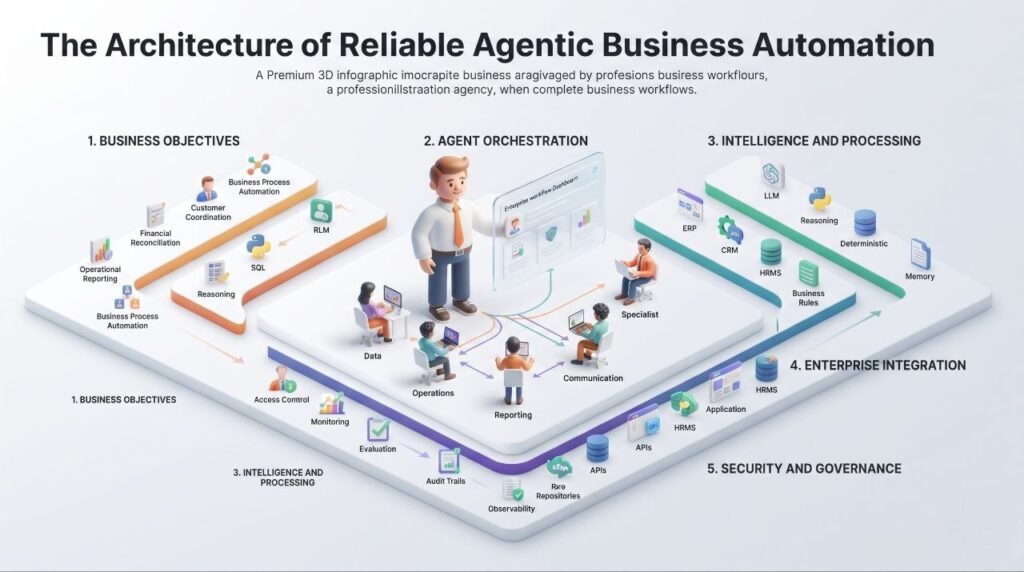
Automating an entire business workflow introduces challenges beyond building an individual agent.
A production-ready architecture needs:
Workflow Orchestration
Manage task sequencing, dependencies, parallel execution and failure recovery.
Context and Memory Management
Maintain relevant business context, historical decisions and task continuity.
Tool Integration
Provide agents with controlled access to enterprise applications and business functions.
Security and Governance
Enforce user permissions, data isolation, authorisation and human approval.
Observability
Monitor agent activities, tool execution, failures, latency, cost and task outcomes.
Evaluation
Measure whether workflows produce accurate and consistent results.
Human-in-the-Loop
Keep people involved where judgement, accountability or sensitive decisions are required.
An agentic system should not be considered successful merely because it can execute a sequence of tool calls.
It must complete the intended business process reliably and within defined operational boundaries.
Technology implementation alone does not create business value.
Businesses need to measure the operational impact of automation.
Some important metrics include:
For example, if an organisation spends 100 employee hours every month consolidating operational reports, an automated workflow may significantly reduce that effort.
However, the actual benefit must be measured against implementation costs, ongoing operating costs, human review requirements and error rates.
The ultimate measure of AI adoption should be business outcomes, not the number of agents deployed.
As we work on AI-powered business solutions across ERP, audit, legal and healthcare, we see a significant opportunity to move beyond isolated AI applications towards integrated business automation.
Our approach is to combine:
For example, in our SME ERP initiative, we are already working with structured operational transactions and deterministic KPI calculations.
The next progression is to introduce intelligent agents that can monitor activities, identify exceptions, coordinate follow-ups, prepare reports and support management decisions.
The objective is not simply to build an AI-enabled ERP.
It is to progressively transform the ERP into an intelligent operational platform where routine business activities can be monitored, coordinated and automated.
The evolution of enterprise AI can be viewed in three stages:
Stage 1: AI Assistance
AI helps employees find information, answer questions and generate content.
Stage 2: AI Agents
AI systems use tools, retrieve information and execute defined tasks.
Stage 3: Agentic Business Workflows
Multiple activities, systems and potentially specialist agents work together to achieve larger business objectives under defined controls.
Not every organisation needs to jump directly to the third stage.
A practical approach is to identify one high-value business process, automate it, measure its performance and progressively expand the automation.
The future of enterprise AI will not be about deploying the largest number of agents.
It will be about identifying the right business processes and engineering intelligent systems that can execute them reliably.
The real transformation begins when AI moves from helping employees perform individual tasks to coordinating and automating complete business workflows.
We believe this is where the next generation of enterprise automation is heading.
Recent Comments