- Contact: +91 9958374323
- Email: info@analytx4t.com
How AI-powered data analysis helps manufacturing organizations identify procurement discrepancies, detect control gaps, validate transactions, and strengthen financial and operational oversight.
Industry: Manufacturing
Business Function: Procurement, Finance, Inventory, and Internal Audit
Solution: AI-Powered Procure-to-Pay (P2P) Audit and Analytics
Core Capabilities: Purchase Order Analysis, Quantity and Price Verification, GRN Validation, Gate-Entry Reconciliation, Invoice and Payment Checks, Vendor Analysis, Transaction Timing Analysis, and Automated Audit Reporting
Procurement is one of the most important operational and financial functions in a manufacturing organization.
From raising purchase orders and receiving materials to performing quality checks, recording goods receipts, processing supplier invoices, and making payments, every stage must follow the organization’s procurement policies and approval procedures.
However, when these activities are spread across purchase registers, purchase orders, goods receipt notes, gate-entry records, stock ledgers, invoices, and payment records, identifying inconsistencies becomes difficult.
A purchase order may contain a quantity that differs from the quantity received. A goods receipt note may be recorded before the material’s actual gate entry. An invoice may include excess quantities. A purchase order may be split into multiple orders. The same item may be purchased at different prices from the same or different vendors. Transactions may also occur on Sundays or holidays, requiring additional verification.
Checking these relationships manually across large datasets is time-consuming and can make it difficult for audit teams to identify patterns across the complete procurement lifecycle.
The AI-powered Procure-to-Pay audit solution addresses this challenge by analyzing procurement and financial records across multiple stages, validating relationships between transactions, identifying exceptions, and generating a consolidated audit report for the administration and management teams.
Rather than reviewing individual records in isolation, the solution examines how the records connect—from purchase order creation and material receipt to invoice processing and final payment.
The result is a more structured approach to procurement auditing, helping organizations identify potential control gaps, prioritize exceptions, and make better-informed decisions.
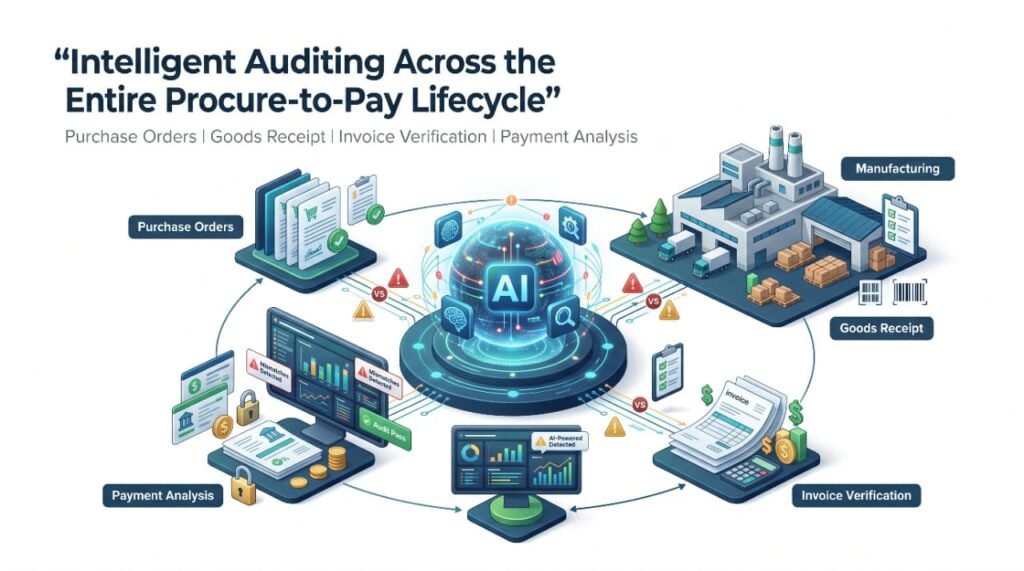
Procure-to-Pay, commonly known as P2P, covers the process through which an organization purchases goods or services and pays its suppliers.
In a manufacturing environment, the process typically includes the following stages:
Each stage creates records that should be consistent with the other stages and comply with the organization’s policies.
For example, the quantity ordered should be reconciled with the quantity received, accepted, invoiced, and paid for. Similarly, the purchase price should be consistent with the approved commercial terms.
The challenge is that these records may be stored in different systems, spreadsheets, or operational registers.
To audit the process properly, the organization needs to examine not only individual transactions but also the relationships and timing between them.
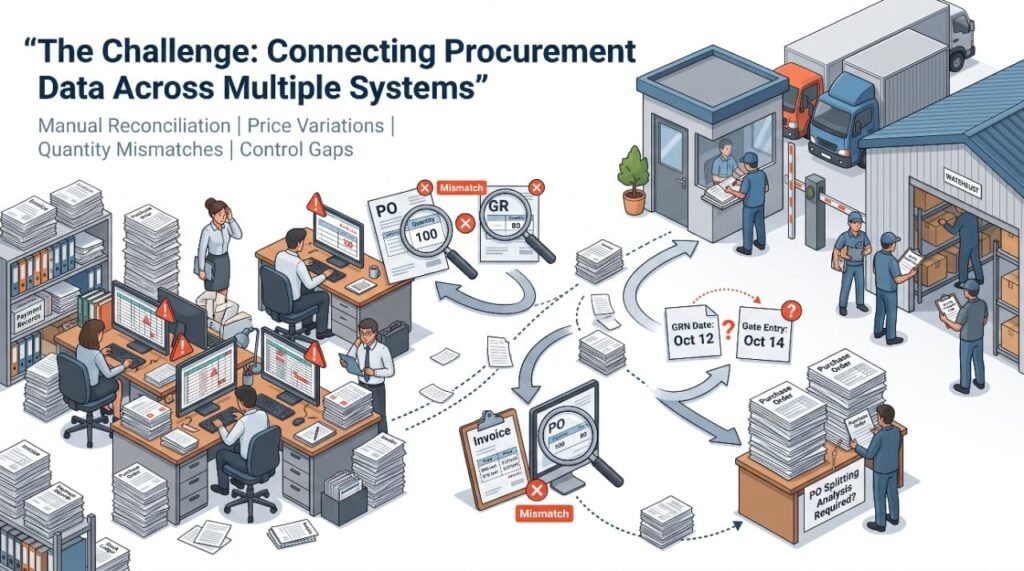
A manufacturing organization may process a large number of purchase orders, suppliers, materials, receipts, invoices, and payments.
Auditors must compare records across multiple datasets, investigate inconsistencies, verify approvals, and determine whether a transaction represents a genuine exception or an acceptable business variation.
Manual analysis creates several challenges:
The objective was to create a systematic way to analyze these records and highlight transactions that deserve further investigation.
The solution brings together procurement, material receipt, inventory, invoicing, and payment data to perform structured audit checks across the Procure-to-Pay lifecycle.
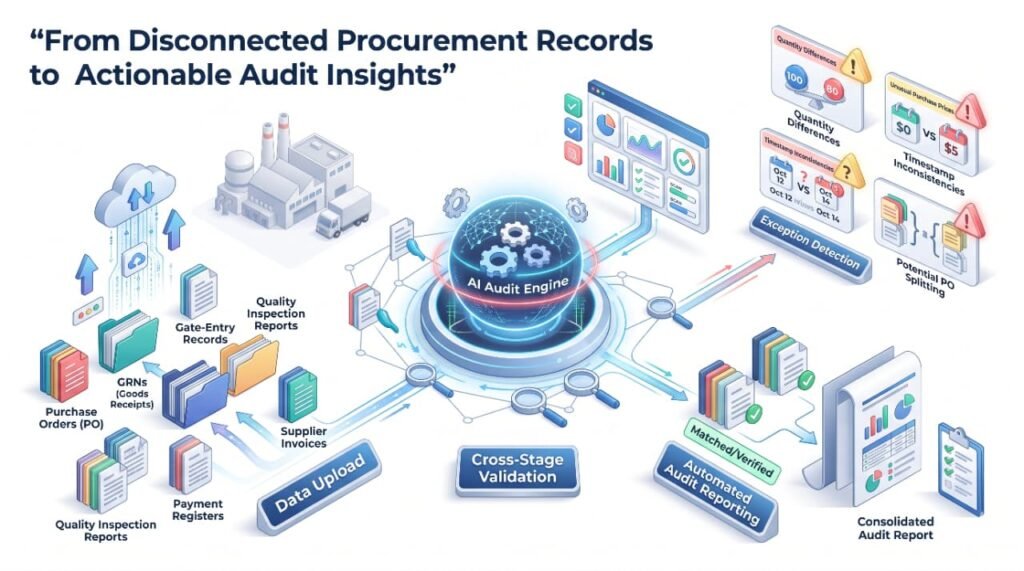
The process begins with uploading the relevant datasets. The system analyzes the available records, establishes relationships between transactions, applies audit checks, identifies exceptions, and consolidates the results into a report for the administration and management teams.
The audit covers multiple dimensions, including:
The key objective is to transform procurement data into actionable audit information.
Instead of requiring auditors to manually compare each register and spreadsheet, the system helps identify records that require closer review.
The workflow begins with uploading the available procurement and financial datasets.
These may include:
The system organizes the uploaded data for analysis and identifies the fields needed to connect related transactions.
Relevant identifiers may include purchase order numbers, item codes, vendor identifiers, GRN numbers, invoice references, receipt dates, quantities, rates, and payment amounts.
The quality and completeness of these fields influence how reliably the records can be linked.
The next step is to connect the records across the procurement lifecycle.
For example, a purchase order may be linked to a material receipt, a GRN, a supplier invoice, and a payment record.
Once these relationships are established, the system can analyze the transaction as a connected process rather than as separate entries in different registers.
This is important because many procurement exceptions become visible only when information from multiple stages is compared.
The system applies a collection of audit checks to the available data.
These checks evaluate quantities, prices, dates, approvals where available, stock movements, and financial amounts.
Each check is designed to identify a specific type of inconsistency or unusual transaction pattern.
Transactions that do not satisfy the applicable audit rules are flagged for review.
Examples include differences between ordered and received quantities, GRNs recorded before gate entry, unusually high purchase prices, and purchase orders created on holidays.
The purpose is not to automatically classify every exception as fraud or misconduct.
Instead, the system highlights transactions that require explanation, supporting evidence, or additional verification.
The identified exceptions are organized into a consolidated report for the administration, management, and audit teams.
The report helps reviewers understand which transactions require attention, why they were flagged, and which records should be examined to verify the issue.
This makes it easier to prioritize audit work and investigate potential control gaps across the procurement lifecycle.
One of the most important procurement controls is ensuring that the quantity ordered is reconciled with the quantity received and accepted.
For example, a purchase order may specify 1,000 units of a particular material, while the receipt records indicate that only 950 units were received.
The audit needs to establish whether the difference is supported by a partial delivery, an outstanding balance, a cancellation, or another valid business explanation.
The reverse situation also requires attention. If 1,050 units are recorded as received against an order for 1,000 units, the additional quantity must be checked against the applicable purchase order terms and authorization.
The audit compares:
Business value: Helps identify over-receipts, short receipts, quantity mismatches, and transactions requiring additional authorization or reconciliation.
Material receipt involves several operational steps.
When materials arrive at a manufacturing facility, the security gate may record the arrival, after which the material proceeds through receipt documentation and, where applicable, quality inspection.
The Goods Receipt Note records the receipt of goods in the purchasing or inventory process.
The timing and sequence of these records can provide important audit evidence.
For example, if a GRN is recorded one day before the corresponding security gate-entry record, the sequence appears inconsistent with the expected physical receipt process.
The system flags such cases for investigation.
Possible explanations may include incorrect dates, delayed data entry, system integration issues, or an actual process-control gap.
The audit examines:
Business value: Helps identify inconsistencies in material receipt documentation and highlights transactions where the recorded sequence requires verification.
Receiving materials does not necessarily mean that all received quantities have passed quality inspection.
Manufacturing organizations may have quality procedures for inspecting, accepting, rejecting, or placing materials on hold.
The audit compares available receipt and quality records to identify inconsistencies.
Examples include:
These checks depend on the availability of quality inspection and acceptance data.
Business value: Helps verify that material acceptance and procurement records are consistent with the organization’s quality-control requirements.
Purchase order splitting is an important area for procurement-control review.
In some circumstances, a large procurement requirement may be divided into multiple purchase orders for legitimate operational reasons.
However, multiple smaller orders may also warrant investigation if they appear to have been created to avoid approval thresholds, delegated authority limits, or other procurement controls.
The audit examines related purchase orders based on factors such as:
For example, several purchase orders for the same material and vendor, created within a short period and with similar quantities, may be flagged if their combined value or timing suggests a potential approval-control issue.
The system helps identify these patterns for further review.
Business value: Supports the identification of potential purchase order splitting and helps procurement teams assess whether approval procedures have been followed.
Receiving more material than the purchase order quantity can create inventory, authorization, and payment risks.
However, excess receipt does not automatically indicate an error. Some organizations permit quantity tolerances or authorized additional deliveries under specific conditions.
The audit compares the ordered quantity with the recorded receipt and the corresponding stock ledger entries.
Where the received quantity exceeds the ordered quantity, the system can flag the difference and help reviewers examine:
This provides a more complete view of the transaction than checking the purchase order and receipt independently.
Business value: Helps identify unauthorized or insufficiently documented excess receipts and potential inconsistencies between physical receipt, inventory records, invoicing, and payment.
Manufacturing organizations often purchase the same material from multiple suppliers.
Price differences can arise from quantity discounts, contractual terms, quality specifications, delivery costs, market conditions, and negotiated agreements.
However, unexplained price differences may indicate an opportunity for cost optimization or a procurement-control concern.
The system performs item-wise and vendor-wise price comparisons to identify significant variations.
For example, the same material may have been purchased at a higher unit price from one vendor than from another vendor during a comparable period.
The analysis can compare:
Comparisons are most meaningful when the material specification, unit of measurement, currency, and commercial conditions are consistent.
Business value: Helps identify price outliers, unexplained vendor-level variations, and opportunities for procurement review and cost optimization.
Price analysis is also important when the same material is purchased from the same vendor at different prices.
For example, a material may be purchased at one unit price in an earlier order and at a significantly higher price in a later order.
The audit compares historical and current purchase prices to identify changes that require explanation.
Potential reasons include contractual revisions, changes in specifications, order quantity differences, market movements, or an updated commercial agreement.
Where such explanations are not apparent from the available data, the transaction can be flagged for further review.
Business value: Supports historical price monitoring and helps identify unusual changes in procurement rates.
Purchase orders created on Sundays or designated holidays may require additional verification, depending on the organization’s operating schedule and approval policies.
Such transactions can be legitimate in businesses with continuous manufacturing operations, emergency procurement requirements, or authorized weekend working.
However, unusual timing can also indicate a process-control exception.
The system analyzes purchase order creation dates against the applicable working calendar and flags transactions created on non-working days.
Where time and approval information are available, reviewers can also examine:
Business value: Helps identify transactions that require confirmation of authorization, business necessity, and compliance with procurement procedures.
A weekend or holiday transaction is treated as an audit exception for review, not as automatic evidence of misconduct.
Supplier invoices should be reconciled with the purchase order, goods receipt, accepted quantity, and applicable commercial terms.
The audit examines whether the invoiced quantity and amount are supported by the corresponding transaction records.
Examples of potential exceptions include:
Where applicable, taxes, freight, discounts, and other commercial adjustments must also be considered.
Business value: Helps identify unsupported invoice quantities, price differences, duplicate-record risks, and inconsistencies requiring verification before or after payment.
The final stage of the Procure-to-Pay process is payment to the supplier.
The audit checks whether the payment records align with the corresponding invoices and the supporting purchase and receipt records.
Relevant comparisons include:
For example, if an invoice includes an excess quantity that was not adequately supported by the receipt records, the audit can flag the relationship for review against the payment record.
The purpose is to identify potential overpayments, duplicate-payment risks, unsupported amounts, and incomplete reconciliation.
Business value: Strengthens financial verification and helps reviewers trace payments back to the underlying procurement transactions.
The time between procurement activities can reveal operational delays and inconsistencies.
The system analyzes the time gaps between relevant stages, such as:
For example, an unusually long gap between gate entry and GRN creation may indicate delayed documentation or an operational bottleneck.
Likewise, a GRN timestamp that precedes the corresponding gate-entry timestamp may indicate an inconsistent transaction sequence.
Time-gap analysis can also help identify unusual processing patterns that warrant further investigation.
Business value: Helps identify process delays, timestamp inconsistencies, and potential control weaknesses across the procurement lifecycle.
The strength of the solution comes from connecting multiple audit checks instead of evaluating every transaction independently.
| Procurement Stage | Records Analyzed | Key Audit Focus |
|---|---|---|
| Purchase order | PO records and approval data | Quantity, price, value, splitting patterns, weekend or holiday orders |
| Material arrival | Security gate-entry records | Physical arrival date, time, and recorded quantity |
| Goods receipt | GRN records | Receipt sequence, quantity differences, PO linkage |
| Quality inspection | Quality and acceptance records | Accepted, rejected, and pending quantities |
| Inventory update | Stock ledger | Quantity movement and excess receipt verification |
| Purchase accounting | Purchase register | Consistency between receipt, invoice, and accounting records |
| Supplier invoicing | Invoice records | Quantity, rate, amount, duplicate references, and supporting documentation |
| Payment | Payment and settlement records | Invoice-to-payment reconciliation and potential overpayment exceptions |
This cross-stage view allows reviewers to follow a transaction from the initial purchase order through receipt, accounting, invoicing, and payment.
It also helps reveal discrepancies that may not be visible when a single register is examined in isolation.
The audit follows a structured data-analysis pipeline:
Data Upload → Data Preparation → Transaction Linking → Audit Rule Execution → Exception Identification → Cross-Stage Verification → Consolidated Audit Report
Each stage has a defined purpose.
| Component | Purpose |
|---|---|
| Data ingestion | Receives the relevant procurement, inventory, invoice, and payment datasets |
| Data preparation | Organizes records and prepares fields for analysis |
| Transaction linking | Connects related purchase orders, receipts, invoices, and payments |
| Audit analysis | Applies quantity, price, timing, and transaction-pattern checks |
| Exception detection | Flags potential mismatches and control gaps |
| Cross-stage verification | Compares findings across multiple procurement records |
| Reporting | Consolidates exceptions into a report for administration and management |
The system’s findings depend on the completeness, accuracy, and linkage quality of the source records.
Where information is missing or transactions cannot be linked reliably, the report should distinguish incomplete evidence from a confirmed discrepancy.
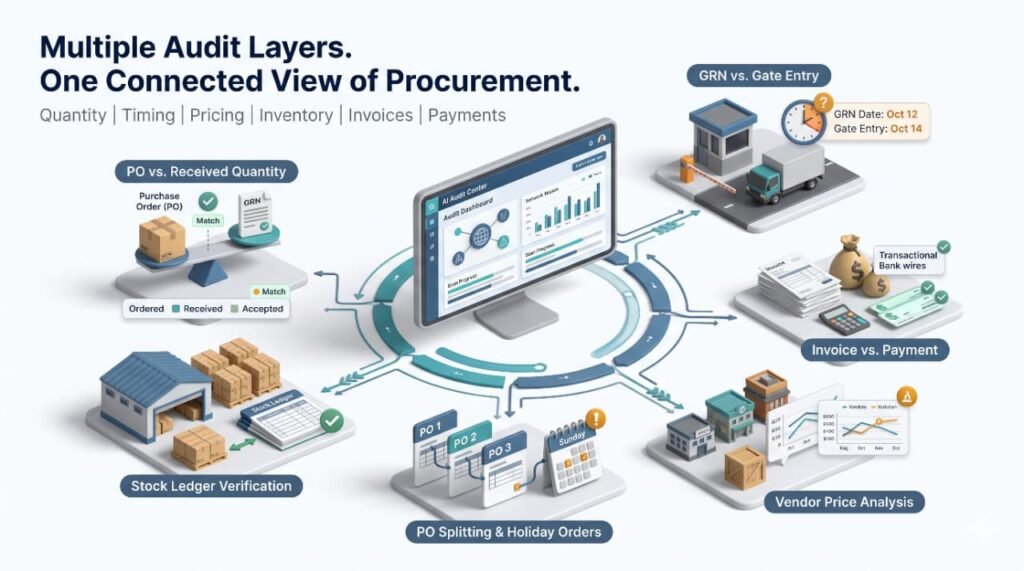
The solution creates a consolidated view of the purchasing process, connecting purchase orders, goods receipts, quality checks, inventory, invoices, and payments.
This makes it easier to understand where an exception occurs and which supporting records should be examined.
Automated checks help identify transactions that require investigation without requiring auditors to manually compare every record from the beginning.
This supports more focused audit reviews and helps prioritize significant discrepancies.
Cross-checking ordered, received, accepted, invoiced, and paid quantities helps identify inconsistencies that could otherwise remain unnoticed across separate registers.
Vendor-wise and item-wise price analysis helps highlight unusual price variations and provides a basis for reviewing procurement decisions and commercial terms.
Analysis of purchase order splitting, holiday transactions, and inconsistent receipt timestamps helps reviewers identify activities that may not align with established procedures.
The system consolidates identified exceptions into a structured report for the administration, management, and audit teams.
This reduces the need to manually compile findings from multiple spreadsheets and supports a more organized review process.
By automating repetitive comparisons and highlighting potential exceptions, the solution allows auditors to focus on investigation, verification, and recommendations.
It supports a shift from checking every record manually toward a more targeted, evidence-driven audit process.
Automated audit checks are most useful when they identify where attention is needed without treating every unusual transaction as proof of wrongdoing.
A price difference may be supported by a contract. A weekend purchase order may be valid for an emergency. A receipt quantity may fall within an authorized tolerance. A timestamp mismatch may result from delayed data entry or a system integration issue.
For this reason, the solution is designed to support audit investigation rather than replace professional judgment.
Important controls include:
This approach helps ensure that the audit output remains useful, traceable, and appropriate for management review.
Procure-to-Pay auditing is not simply a financial reconciliation exercise. It is a way to understand whether purchasing activities, material movements, commercial decisions, and payments are aligned with the organization’s operating procedures.
When the relevant data is connected, organizations can examine procurement from several perspectives:
The same analytical approach can support recurring audits and broader procurement analytics, provided the required source data and business rules are available.
Rather than relying entirely on periodic manual checks, organizations can establish a more structured approach to identifying unusual transactions and monitoring procurement controls.
Manufacturing procurement involves a connected sequence of commercial, operational, inventory, and financial activities.
A purchase order must be evaluated against what was received. Receipt records must be consistent with gate-entry and quality documentation. Inventory movements must align with the recorded quantities. Supplier invoices and payments must be supported by the underlying transactions.
When these records are examined separately, important discrepancies can be difficult to identify.
The AI-powered Procure-to-Pay audit solution brings these records together to analyze quantity differences, GRN and gate-entry inconsistencies, quality checks, excess receipts, purchase order splitting patterns, vendor price variations, holiday transactions, time gaps, invoice discrepancies, and payment records.
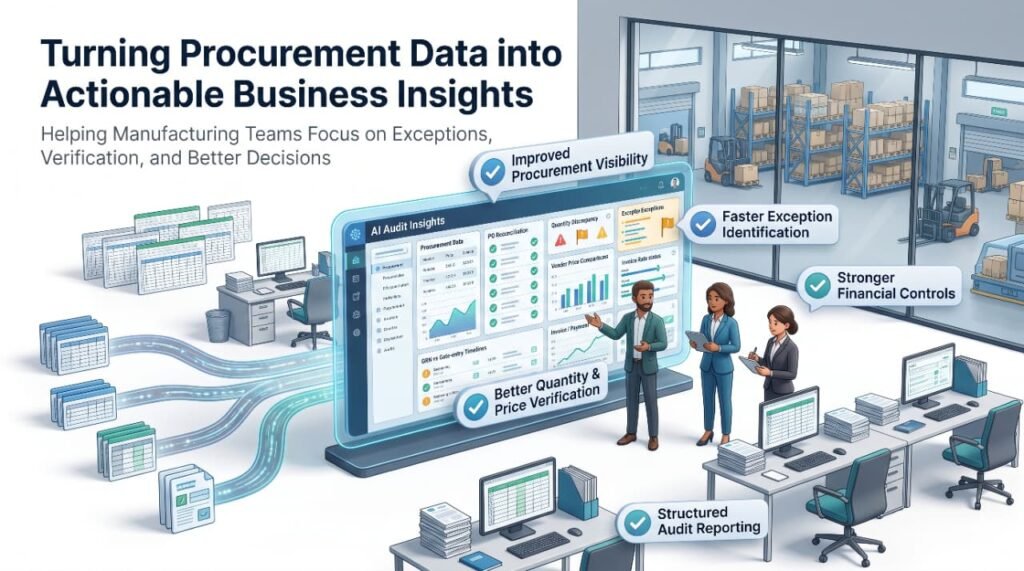
By automatically identifying potential exceptions and consolidating the findings into an audit report, the solution helps manufacturing organizations improve procurement visibility, focus investigation efforts, and strengthen operational and financial controls.
The real value of AI-powered procurement auditing is not just finding mismatches. It is connecting the complete transaction lifecycle so organizations can understand what happened, identify where controls may have failed, and determine what needs to be verified.
A more connected, data-driven audit process gives procurement, finance, inventory, and management teams a clearer foundation for making informed decisions
Recent Comments